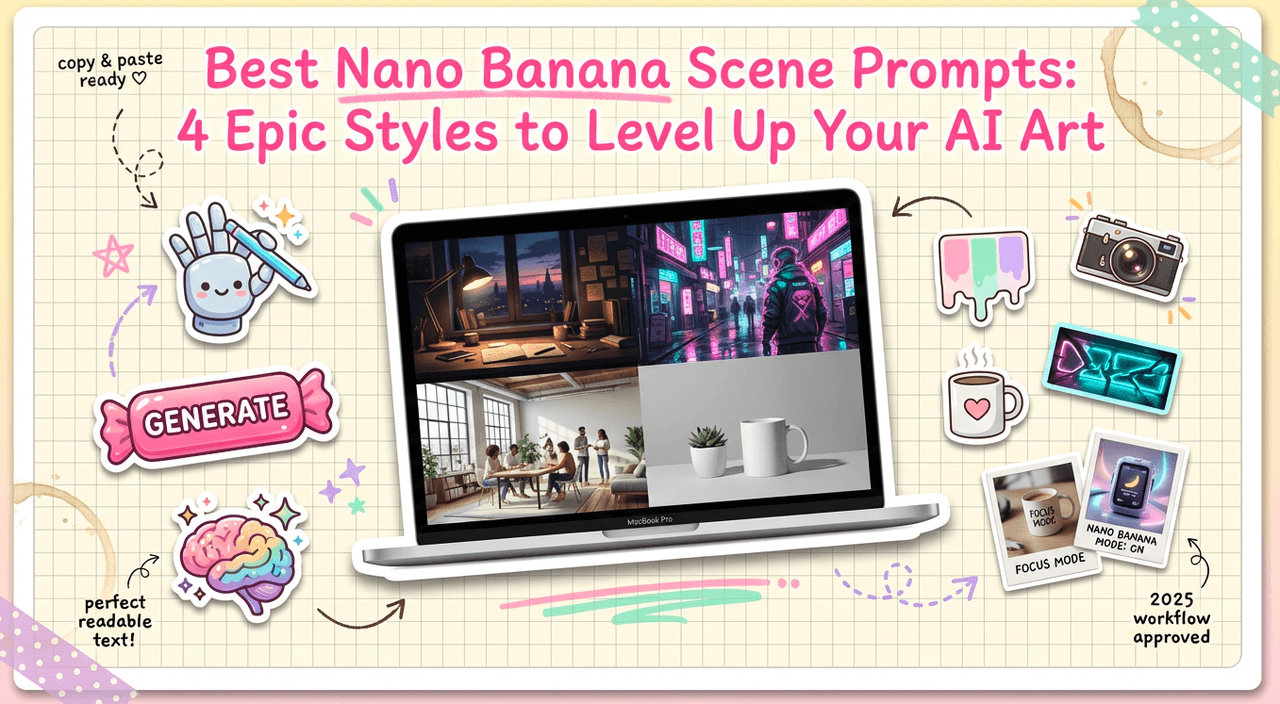
If you're juggling client deadlines, content calendars, and way too many tabs, you don't have hours to engineer the "perfect" AI image prompt. I've been there, writing the same scene five different ways just to get legible text or a decent composition.
In this guide, I'm sharing my best Nano Banana scene prompts, grouped by style, so you can generate photorealistic images (with accurate on-image text) in a few minutes instead of a few evenings. AI tools evolve rapidly. Features described here are accurate as of December 2025.
Use these as copy‑paste starting points, then tweak details (subject, brand, language) for your own workflow.
Cinematic Prompts for Dramatic, Film-Like Results
When I want images that feel like stills from a movie, I build prompts around lens, lighting, and mood. Think in terms of "scenes," not just "objects."
Moody, Character-Driven Shots
cinematic scene in the style of a modern drama, medium close-up of a young designer sitting at a cluttered desk at night, only lit by a laptop screen and a neon sign outside the window, shallow depth of field, 35mm lens, realistic skin texture, visible dust in the air, film grain, color graded like a Netflix original series, on-screen laptop text clearly readable: "FINAL LAUNCH PLAN"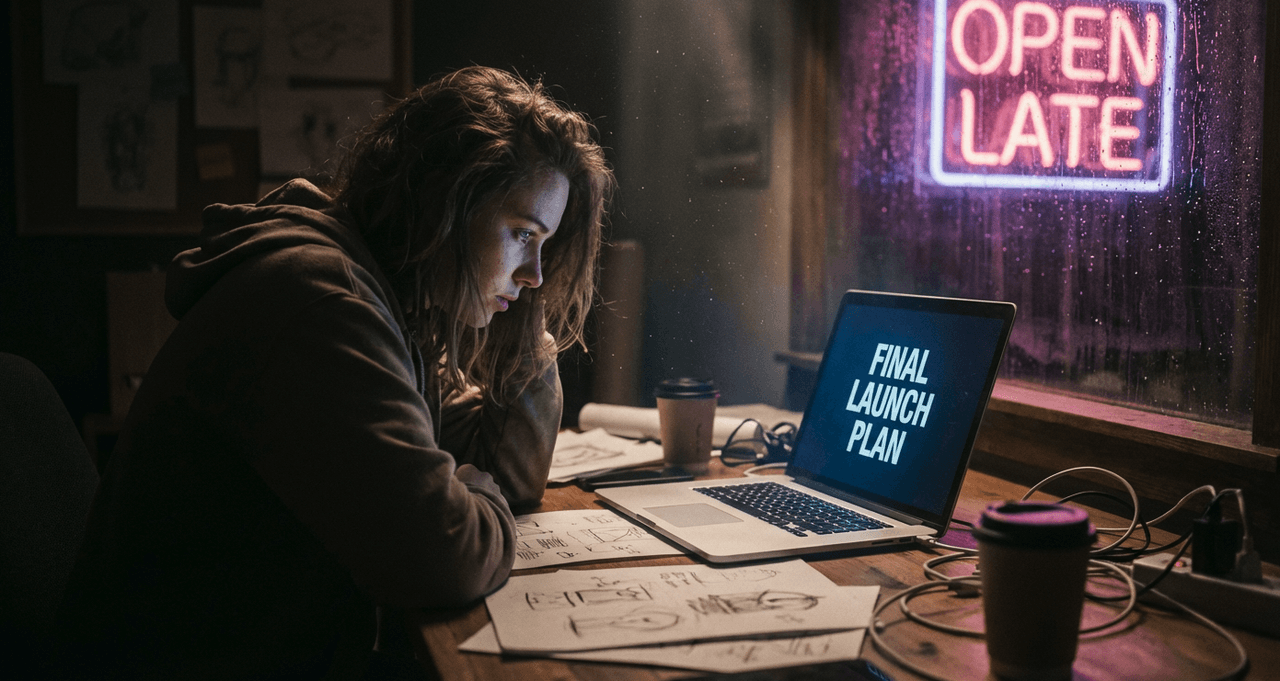
wide establishing shot of a rainy city street at dusk, camera low to the ground, reflections of headlights in wet asphalt, anonymous figure holding a transparent umbrella crossing the frame, subtle motion blur, anamorphic lens flares, cool blue and amber color grade, ultra photorealistic, cinematic ratio 2.39:1, high dynamic range lightingProduct & Brand Story Scenes
cinematic product hero shot of a matte black coffee mug on a wooden table, morning light streaming through a nearby window, soft steam rising, shallow depth of field, 50mm lens, strong contrast between highlights and shadows, warm color grade, realistic ceramic texture, legible text on mug in clean sans-serif font: "FOCUS MODE"over-the-shoulder cinematic shot of a marketer reviewing a campaign board covered in printed mockups, office backlight at golden hour, lens flare on the edge of frame, filmic color grading, subtle grain, realistic paper textures and pinned notes, text on main headline clearly readable: "Q1 GROWTH STRATEGY"Neon & Cyberpunk Styles for Futuristic Visuals
Neon and cyberpunk styles are great when I need something eye-catching for thumbnails, social banners, or speculative product concepts. This is the detail that changes the outcome: specify where the light comes from and how it hits your subject.
Futuristic City & Street Scenes
cyberpunk city street at night, heavy rain, puddles reflecting holographic billboards, narrow alley packed with cables and pipes, dense neon signs in magenta and cyan, realistic wet asphalt, cinematic composition, shallow depth of field, ultra detailed, English and Japanese signage with clearly readable shop name: "NANO BITE CAFE"rooftop scene overlooking a futuristic skyline, lone figure in a reflective jacket standing at the edge, neon blue and purple rim lighting, volumetric fog, distant drones flying between skyscrapers, 85mm lens compression, high contrast, photorealistic, subtle film grainTech Product & Interface Mockups
futuristic holographic dashboard floating above a sleek white desk, soft blue neon UI elements, clean minimal icons, dark room with subtle rim lighting on a mechanical keyboard, ultra sharp details, realistic reflections on glass, readable main dashboard label: "CREATOR CONTROL PANEL"close-up cyberpunk handheld device on a metal surface, glowing cyan edges, scratched anodized aluminum texture, moody purple backlight, shallow depth of field, cinematic lighting, realistic wear and tear, UI screen text legible: "NANO BANANA MODE: ON"
For more on building effective prompts around lighting and color, I'd cross-reference guidance from prompt design resources like official documentation on image generation, and this internal explainer on composition in AI images: latest technical updates on Gemini.
Editorial Prompts for Professional Visual Storytelling
When I'm aiming for "magazine spread" energy, I lean into context: who, what, where, and why. Editorial prompts should feel like a photo assignment.
Lifestyle & Brand Editorial
editorial photo for a creative business magazine, diverse team of three founders standing in a bright loft studio, large windows, natural daylight, plants and moodboards in the background, candid laughing moment, subtle motion blur on hands, shot on 50mm lens, soft contrast, realistic skin and fabric textures, cover headline text clearly readable at top: "INDEPENDENT CREATORS, BIG IMPACT"flat lay editorial image for a productivity blog, overhead shot of a wooden desk with a laptop, notebook, pen, phone, and coffee, soft window light from the left, minimal shadows, warm tones, realistic textures, legible handwritten text in notebook: "content ideas" with bullet points
Thought Leadership & Article Headers
professional editorial portrait of a solo creator working from a small apartment, window light on one side of the face, books and camera gear blurred in background, muted color palette, subtle film grain, realistic skin and hair, space at top for headline, placeholder headline text clearly readable: "THE NEW CREATOR ECONOMY"conceptual editorial image illustrating "burnout vs balance" for a marketing blog, split-screen style scene: left side cluttered chaotic desk with harsh cool lighting, right side clean calm desk with warm soft lighting and a plant, overhead view, photorealistic, strong contrast between sides, readable sticky note on calm side: "Take a break"If you want deeper theory on editorial framing, it's worth pairing practice with general prompt-writing principles from sources like prompt-writing best practices and ultimate guide to writing AI prompts.
Minimalist Scenes for Clean and Modern Aesthetics
Minimalist prompts help me design landing page hero images, app previews, and clean social graphics that don't fight the text.
Simple Product & Workspace Scenes
ultra-minimalist scene, single white ceramic mug on a light gray background, soft diffused studio lighting, no clutter, subtle shadow, high resolution, photorealistic, centered composition, readable small text on mug in thin sans-serif font: "create daily"clean modern workspace, top-down view of a light wood desk with only a laptop, wireless mouse, and a small plant, neutral color palette, soft natural light, no visible cables, photorealistic, space on the right side with empty area for overlay textMinimalist Brand & UI Concepts
minimalist smartphone mockup standing vertically on a plain pastel background, soft studio light, subtle reflection on screen, ultra-detailed edges and buttons, photorealistic, simple UI on screen with clearly readable app name: "Nano Focus"
simple overhead shot of a blank white notebook and a black pen on a beige background, strong but soft directional light from the top, crisp shadows, high resolution, no extra objects, small handwritten title on notebook clearly readable: "Brand Ideas"Counter-intuitively, I found that stripping details back this far often gives Nano Banana more "room" to render crisp, readable text and accurate geometry, especially for social tiles and ad creatives.
Expert Tips: How to Refine Scene Prompts in Nano Banana
Good prompts start the image: refinement finishes it. Here's how I iterate without burning time.
Fast Iteration Workflow
- Start broad, then specialize.
-
First, I describe subject, setting, and lighting in plain language.
-
Next passes add lens, mood, and specific text.
- Lock composition before chasing style.
-
I get a usable angle and framing first.
-
Then I add tags like cinematic lighting, film grain, or cyberpunk neon.
- Test text placement explicitly.
-
I literally say text clearly readable: "YOUR PHRASE".
-
If text warps, I reduce clutter and contrast near the typography.
For more method-level advice on prompt testing, I lean on general best practices from places like prompting tips for Nano Banana.
Where Nano Banana Struggles
Even with strong prompts, there are limits:
-
Pixel-perfect logos and vector art. If I need production-ready SVG logos, I still design them in tools like Illustrator or Figma.
-
Dense paragraphs of on-image text. Short phrases and headlines work best. For longer copy, I keep the layout in my design tool and let Nano Banana handle the imagery.
-
Highly technical diagrams. I'll rough them out with AI, then rebuild manually for clarity and brand consistency.
Ethical Considerations in 2025
Because these workflows ship content fast, I keep three guardrails in place:
-
Transparency. I clearly label AI-generated visuals in my credits or alt text (e.g., "Image generated with Nano Banana"). It builds trust with clients and audiences.
-
Bias awareness. When prompts include people, I specify diversity or neutral attributes, then review outputs for stereotypes. If something feels off, I regenerate or adjust the brief.
-
Copyright & ownership. I avoid asking Nano Banana to imitate living artists or specific photographers by name. For commercial work, I check license terms for both the model and any reference assets, and I treat AI outputs as drafts until legal is comfortable.
Putting It All Together
My usual routine is simple:
-
Pick a style section above (cinematic, neon, editorial, minimalist).
-
Paste one prompt into Nano Banana.
-
Swap in my brand text, colors, or subject.
-
Generate 3–4 variations, then fine-tune composition or text.
Used this way, Nano Banana becomes a fast sketch partner rather than a black box lottery.
Did we miss a prompt you love? Share it below.